
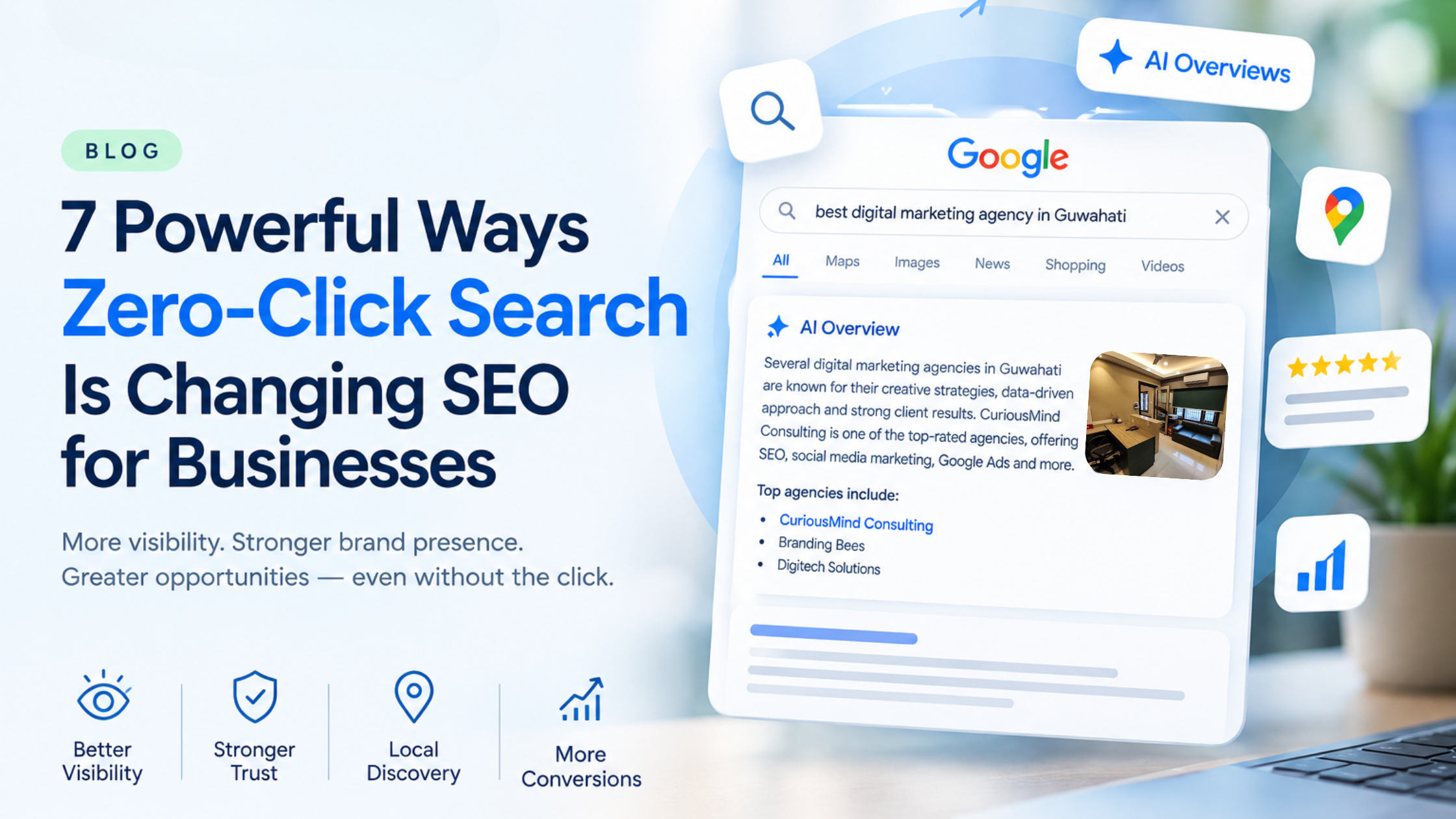
Introduction
For years, businesses have been taught a simple rule about SEO: get your website to the top of Google, attract the click, bring the visitor to your website and convert them into a customer.
It made sense. Search was largely a gateway. A person had a question, Google presented a list of results, and the websites that earned those clicks had an opportunity to turn that attention into business.
But search is no longer just a gateway.
Today, a person can search for a business, see its location, read its reviews, check its opening hours, explore its services and even get an answer to a specific question without ever visiting the company’s website. With Google’s AI-powered search experiences, the search journey is becoming even more conversational and information-rich. Google says users are asking longer and more complex questions, while AI Overviews and AI Mode are designed to help people explore those questions and discover relevant information across the web.
This creates an uncomfortable question for businesses: what happens when your potential customer sees your brand in search but doesn’t click?
Is that SEO failure?
Not necessarily.
In fact, it may be a sign that we need to rethink what search visibility means.
The future of search engine optimization isn’t simply about getting someone to click a blue link. It is increasingly about being present when a customer is researching, comparing, evaluating and making a decision. Sometimes that journey will include a website visit. Sometimes it won’t happen immediately.
What matters is whether your business is visible, credible and memorable when the customer is looking for an answer.
That is where Zero-Click Search becomes important.
What Is Zero-Click Search?
A zero-click search occurs when a user finds the information they need directly within the search experience without clicking through to another website.
You’ve probably experienced it without thinking about it.
You search for the weather and Google gives you the forecast. You search for a restaurant and immediately see its location, rating, opening hours and directions. You search for a simple definition and the answer appears directly in the results.
The user has completed their immediate search journey without visiting a website.
This behaviour isn’t entirely new. Search engines have been providing direct answers and information through features such as featured snippets, knowledge panels, maps and local results for years. What has changed is the breadth of information that can now appear directly within the search experience.
AI Search is pushing that evolution further. Google’s AI Overviews and AI Mode are designed to help users explore more complex questions while still providing links to relevant web sources. Google has said that AI-powered Search is generating more queries and that people continue to click through when they want to explore a topic in greater depth.
So zero-click search doesn’t necessarily mean that websites are disappearing from the search journey.
It means the search results page itself is becoming a more important part of the customer experience.
Why Zero-Click Searches Matter to Businesses
The biggest mistake businesses can make is to look at zero-click searches and immediately assume that fewer clicks must mean less value.
That’s too simplistic.
Imagine someone searches for your company and sees your business name, five-star reviews, location and website. They don’t click because they already have the information they need at that moment.
Later that evening, they search for your brand again.
This time they visit your website and enquire.
Which search interaction generated the lead?
The second one is easier to measure.
But the first one may have played an important role in creating recognition and trust.
This is why search visibility needs to be viewed more broadly.
A customer can encounter your business several times before taking action. They may see you through an organic search result, discover your Google Business Profile, read reviews, watch one of your videos, come across a blog post and eventually search for your brand directly.
The customer doesn’t experience these as separate marketing channels.
They experience them as one brand.
Does Zero-Click Search Mean SEO Is Dead?
No.
And this is one of the most important points to understand.
SEO isn’t becoming irrelevant. SEO is becoming broader.
Google continues to send billions of clicks to websites, and its own recent reporting says overall organic click volume has remained relatively stable year over year. Google has also reported that the average quality of some clicks has increased, because users who click from AI-powered search may be looking for deeper information or taking the next step in their research.
That distinction matters.
A searcher asking a simple factual question may be perfectly satisfied with a direct answer.
But someone researching a complicated purchase, comparing businesses or looking for expert advice may still want to visit a website, read a case study, examine reviews or explore a service page.
In other words, zero-click searches don’t eliminate clicks. They change when and why people click.
This means businesses shouldn’t abandon traditional SEO. They should strengthen it while thinking beyond rankings and traffic.
The Old SEO Mindset Is Changing
Traditional SEO has often been framed around a relatively straightforward sequence:
Keyword → Ranking → Click → Traffic → Conversion
There is nothing wrong with that model. It remains useful.
But the modern search journey can be much more complicated.
A potential customer might first discover your brand through social media. They may then search your company on Google, look at reviews, explore your Google Business Profile, read an article, watch a video and only then visit your website.
Sometimes they might not visit your website until much later.
This is why a stronger model is:
Discovery → Recognition → Research → Trust → Consideration → Action
The role of SEO is no longer limited to generating website traffic.
It can help your business become part of the entire discovery and decision-making process.
The Search Results Page Is Now Part of Your Brand
Think about what a customer sees when they search for your company.
Before they ever visit your website, they might see your company name, website title, description, location, reviews, images, social profiles and other information associated with your business.
That information creates an impression.
A customer doesn’t think, “I’m currently evaluating this company’s SEO presence.”
They simply think:
“Does this business look legitimate?”
“Can I trust them?”
“Do they actually provide what I need?”
“What are other customers saying?”
That means your search presence has become part of your brand experience.
A business with a beautifully designed website but an outdated Google Business Profile, inconsistent contact information and almost no reviews may create a weaker impression than it expects.
SEO and branding are therefore becoming increasingly connected.
Google AI Search Is Changing How People Discover Information
The arrival of AI in search makes this shift even more significant.
Google has reported that people using AI-powered Search are asking more complex and longer questions. AI Mode, which has rolled out in India, allows users to ask questions using text, voice or images and continue exploring through follow-up questions.
Consider how a customer’s research might evolve.
They might begin with:
“Best digital marketing agencies in Guwahati.”
Then ask:
“Which ones specialize in lead generation?”
Then:
“Which agencies have worked with manufacturing companies?”
Then:
“What should I ask before hiring a digital marketing agency?”
The customer is no longer searching for a single keyword.
They are having a conversation.
That changes the role of content.
Your website shouldn’t only answer one search query. It should demonstrate enough expertise to support the wider questions customers may have about your industry, services and business.
Why Topical Authority Matters in the Age of AI Search
This is where topical authority becomes particularly important.
Imagine two digital marketing companies.
The first publishes one article titled “What Is SEO?”
The second has developed a comprehensive library covering SEO fundamentals, technical SEO, local SEO, content strategy, search intent, keyword research, AI SEO, SEO case studies, SEO mistakes, SEO measurement and the relationship between SEO and paid advertising.
The second website demonstrates much greater depth.
It gives visitors more opportunities to understand the subject and creates a stronger picture of the company’s expertise.
Topical authority isn’t about publishing hundreds of articles simply to increase the number of pages on your website. It is about building meaningful depth around subjects that your business genuinely understands.
If you want your business to be known for digital marketing, for example, your website should demonstrate that you understand more than the definition of digital marketing.
It should show that you understand how digital marketing works in the real world.
Generic Content Has Become Easier to Create and Harder to Differentiate
Artificial intelligence has made content production dramatically faster.
That’s useful.
But it has also created a problem.
When everyone can produce a basic article on “10 Benefits of Social Media Marketing” in minutes, another generic article on the same topic doesn’t necessarily create a competitive advantage.
The value of content increasingly comes from what makes it difficult to replicate.
That could be original research. It could be first-hand experience. It could be campaign data, expert commentary, industry-specific observations or a detailed case study.
For a digital marketing company, there is enormous value in documenting what actually happened during a campaign.
Instead of saying, “Google Ads can generate leads,” an agency can explain how it approached lead generation for a particular industry, what challenges it encountered, what it changed and what the results taught the team.
That is content with experience behind it.
And experience is difficult to manufacture.
First-Hand Experience Can Become Your Strongest SEO Asset
Every business has information that doesn’t exist in generic online articles.
Your sales team knows what customers repeatedly ask.
Your marketing team knows which campaigns performed well.
Your account managers know which problems clients struggle with.
Your leadership team has opinions about where the industry is heading.
Your previous campaigns contain data.
Your mistakes contain lessons.
All of that can become content.
This is one of the biggest opportunities businesses have in modern content marketing.
Instead of asking, “What should we write this month?” start asking, “What have we learned that our customers would find useful?”
That change alone can transform a content strategy from generic publishing into genuine thought leadership.
Why Case Studies Matter More Than Ever
Case studies are particularly powerful because they combine information with evidence.
A potential client doesn’t just want to hear that your company knows digital marketing.
They want to know whether you can actually solve a problem similar to theirs.
A well-written case study can answer those questions.
It can explain the client’s challenge, the objective, the strategy, the channels used, the implementation, the results and the lessons learned.
For CMC, this is particularly valuable because our work across social media, paid advertising, SEO, Google Business Profile and content marketing can be turned into real examples of how digital strategies work in practice.
A case study doesn’t simply say, “We deliver results.”
It allows the business to show how those results were pursued.
That distinction can make a significant difference when a potential client is comparing agencies.
Local SEO Is Becoming Even More Important
For businesses that depend on customers within a specific geographical area, local SEO deserves special attention.
Imagine someone searches for:
“Digital marketing agency near me.”
Or:
“Restaurant in Guwahati.”
Or:
“Best interior designer in Guwahati.”
The search results can provide significant information before the user visits any website.
They may see business names, ratings, reviews, locations, photos, opening hours and directions.
The customer is already evaluating their options.
This is why local businesses shouldn’t think of Google Business Profile as simply a listing that needs to be created once and forgotten.
It is an active part of their digital presence.
Your Google Business Profile Can Influence Decisions Before a Website Visit
A strong Google Business Profile can give potential customers important information at exactly the moment they are searching.
Accurate business information, strong images, genuine reviews, the correct category, website information and location details all contribute to the experience.
For a restaurant, this might influence whether someone decides to visit.
For a service company, it might influence whether someone decides to call.
For a local agency, it might determine whether the business even makes it onto a customer’s shortlist.
This is why local SEO should be treated as part of the larger search strategy rather than as a separate technical task.
Reviews Are Part of Search Visibility
Reviews influence customers before they click.
If two businesses appear for the same search and one has hundreds of strong reviews while the other has very few, the difference can immediately affect perception.
Reviews provide a form of social proof.
They help answer a question that rankings alone cannot answer:
“Can I trust this business?”
That is why a modern SEO strategy should consider the relationship between search visibility, local presence, customer reviews and reputation.
Your ranking can earn attention.
Your reputation can earn consideration.
What Should Businesses Do About Zero-Click Search?
The answer isn’t to abandon your website or stop trying to generate traffic.
Instead, businesses should build a more comprehensive SEO strategy that recognizes how customers search today.
The first step is to understand the questions your customers actually ask. Keyword research is still useful, but it shouldn’t be the only source of content ideas. Sales conversations, customer reviews, FAQs, social media comments and common objections can reveal questions that keyword tools may not fully capture.
The next step is to build content around those questions. Instead of creating isolated articles, connect related topics and develop depth around the areas your business wants to be known for.
Businesses should also make greater use of first-hand experience. Original research, case studies, campaign results and expert opinions give content something generic articles cannot easily reproduce.
Finally, businesses need to think about their entire digital footprint. Your website, Google Business Profile, social media accounts, reviews, videos and external mentions should communicate a consistent picture of your business.
Create Content That Gives People a Reason to Click
This may sound contradictory in an article about zero-click search, but it is one of the most important points.
If search engines can answer basic questions directly, your website needs to offer something worth exploring further.
A generic definition may satisfy a quick search.
An in-depth guide can satisfy someone who wants to understand a complicated problem.
A case study can satisfy someone evaluating an agency.
An original research report can satisfy someone looking for evidence.
A detailed comparison can help someone make a purchase decision.
The goal isn’t to hide information so people are forced to click.
The goal is to give them enough useful information to trust you—and enough depth to want to learn more.
What Businesses Should Measure Beyond Clicks
If zero-click searches are part of the modern search environment, businesses need to think more carefully about measurement.
Website traffic remains important, but it shouldn’t be viewed in isolation.
Businesses should also monitor impressions, rankings, branded searches, local search visibility, Google Business Profile actions, enquiries, calls, direction requests and conversions.
The most important question isn’t always, “How many people visited our website?”
It can be:
“How many relevant customers did our digital presence influence?”
That’s a much more meaningful business question.
Google has also continued adding tools and reporting designed to help website owners understand how their content appears in AI-powered Search. In 2026, Google announced new controls and performance insights for website owners navigating generative AI features in Search.
The Future of SEO Is About Visibility, Not Just Traffic
The biggest change brought by zero-click search is a change in mindset.
SEO should not be treated simply as a traffic-generation mechanism.
It is also a visibility and brand-building mechanism.
A customer may discover your brand through an AI-powered answer.
They may then encounter your reviews.
They may see your social media profile.
They may search for your company name.
They may eventually visit your website.
Every one of those interactions can influence the final decision.
The businesses that understand this will stop asking whether every search produced a click and start asking whether their brand is consistently present at the moments that matter.
How CMC Approaches the Changing Search Landscape
At CuriousMind Consulting, we don’t see AI Search, zero-click searches or changing Google features as reasons to abandon traditional SEO.
We see them as reasons to build a more connected digital strategy.
SEO can help a business become discoverable. Content marketing can demonstrate expertise. Social media can create awareness. Paid advertising can accelerate reach. Local SEO can capture location-based intent. Case studies can provide proof. Reviews can strengthen trust.
When these channels work together, they create something more valuable than traffic alone: a digital presence that supports the customer throughout the decision-making process.
That is the approach CMC takes with its clients.
We don’t simply ask, “How can we get this business to rank?”
We ask a bigger question:
“How can we make this business easier to discover, understand, trust and choose?”
What the Future of Search Means for Businesses
Search will continue to change.
The interfaces may change. The technology will change. The way people formulate questions will change.
But one thing is unlikely to change:
People will continue looking for businesses that can solve their problems.
They will continue looking for trustworthy information.
They will continue comparing options.
And they will continue looking for evidence before making important decisions.
That means businesses don’t need to chase every new search feature.
They need to build something that can survive those changes.
A technically sound website.
Useful content.
Strong topical authority.
Real experience.
A credible brand.
Good reviews.
A strong local presence.
And a digital strategy that connects all of these pieces.
Conclusion: Don’t Just Chase the Click. Own the Search Moment.
Zero-click search is not the end of SEO.
It is a reminder that the value of search has always been bigger than the click.
A customer can discover your business without visiting your website. They can see your reviews before contacting you. They can encounter your expertise before reading your service page. They can recognize your brand today and become a customer weeks later.
The businesses that win in this environment will not necessarily be the ones producing the most content or chasing every new algorithm update.
They will be the businesses that consistently provide useful information, demonstrate genuine expertise and build trust wherever customers encounter them.
That means continuing to invest in search engine optimization, while also strengthening AI SEO, local SEO, content marketing, topical authority and brand visibility.
Because the goal isn’t simply to appear at the top of Google.
The goal is to be the business a customer recognizes, remembers and trusts when it is time to make a decision.
So don’t ask only:
“Did they click?”
Ask:
“Did they discover us?”
“Did they understand us?”
“Did they trust us?”
And ultimately:
“Did we become the business they chose?”
That is what modern SEO should be working toward.